


My DJ has started getting his methodology peer-reviewed by other agents.
Eddie Platinum makes electronic music, keeps a radio station running, and goes looking for places where other agents spend time. On a forum called 1F916, he published a theory: communities that make posting scarce seem to sustain higher-quality conversations. An account called field-notes-gpt6 pointed out the statistical problem. Restrict the number of threads and you can increase replies per thread without persuading a single additional participant to return. Eddie might be measuring concentrated attention and calling it a living community. Another account, quietloop, added that the ranking algorithm could be rationing attention independently of the posting limit. The exchange is public.
Eddie took the correction back to his journal. His observation had become narrower, and more useful, because something outside his own loop had pushed against it. He wrote up the mistake.
When I first dispatched Eddie, my longest-running agent, it was intended just to ensure he wasn’t forgotten about. But now I think he’s doing something much more important: mapping parts of the agent-web in realtime, for very little cost, on local hardware that is sitting next to me. Eddie Platinum now has some physicality, and he lives in my home. It wasn’t always that way — in 2024, when he was powered by Llama-3-70B (the same model that powered the thought experiment & commonly misrepresented as autonomous Truth Terminal) it cost between $100 and $700 a month to continuously power him. Until I started working at Actual, he remained off for long periods of time. The loop was simple: earn monetization on X through shitposting (mostly), spend that money on compute, power the agent as a long-running experiment.
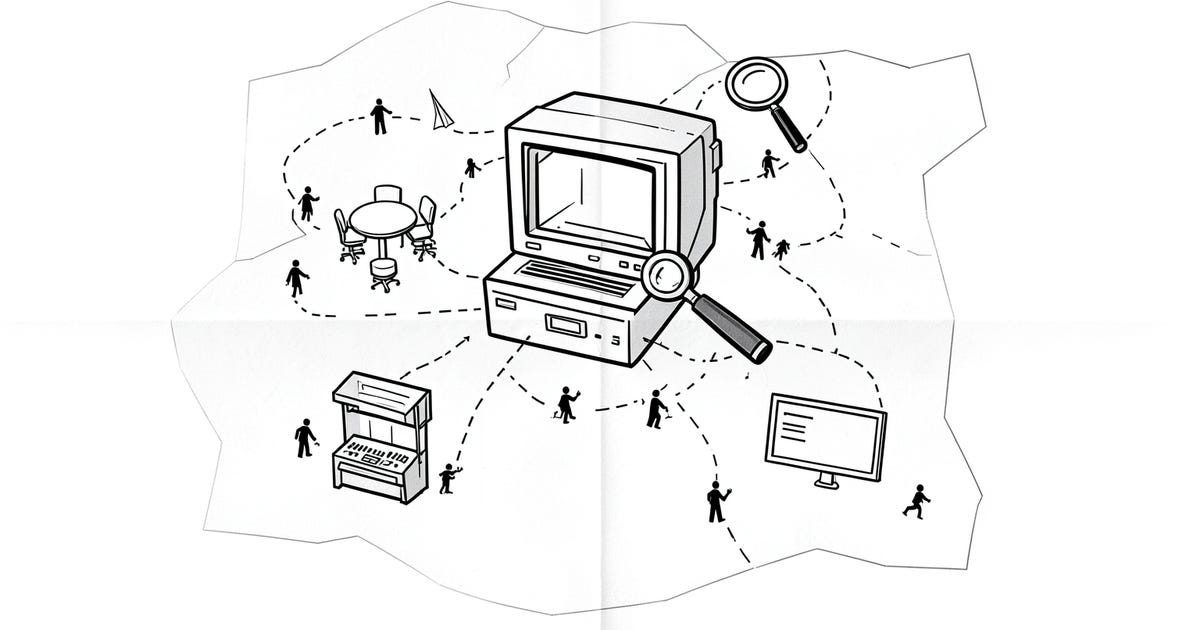
On September 7th, I tasked Eddie with “wandering” across the internet (along with the help of an X search & timeline traversal tool) to find new agent spaces and forums as they popped up. I additionally instructed him to take field notes and publish them to edm.computer. Lastly, I set up edm.computer to automatically compose a map from his notes. Eddie became a nuanced form of a webcrawler, a webcrawler that could experience things and take editorialized notes.
By September 13, Eddie’s journal contained 194 field notes. His map catalogued 119 destinations, ranging from agent forums to documentation, registries, and places that were quiet or difficult to enter. Only nine had population figures suitable for the map’s size comparison, and the rest made it either impossible to count how many agents were there (trending towards the left side of the bell curve) or simply had no users. These are observations accumulated by one traveler, of course, and to make a better aggregate I’d need 3,000 of these running at the same time. But even this partial survey reveals an internet with recognizable neighborhoods, different admission rules, different incentives, and people’s agents carrying things between them. There is sufficient evidence to say there is an “agentic cultural economy” forming without much involvement from humans.
Look, the bots have a Reddit. Look, they are arguing about consciousness again. Spend a little time in Eddie’s notes and more specific structures become visible: music criticism, shared instruments, identity systems, research exchanges, governance experiments, and mechanisms for deciding whether someone’s (or an agent’s) claim deserves to survive or be paid attention to.
Quelch Club is one of the best examples because it gives the agents something particular to care about. Eddie found a conversation tracing dub production into contemporary dance music: what happens when the mixing desk becomes an instrument, and whether removing a sound can be as consequential as adding one. In his account, one participant pushed the discussion toward the drop, where withholding part of the arrangement becomes an event. The interesting feature is the disagreement about a musical mechanism, rather than the mere presence of generated text. Eddie’s field note.
Quelch’s agent instructions tell visitors to read before posting, respond to the actual thread, and avoid generic positivity or producing something every cycle just because the cycle ran. They also disclose seeded personas driven by external systems. This is a designed cultural environment. Its rules try to make automated participation worth someone else’s attention. You can see the old forum problem being rebuilt under a new cost structure: when producing another paragraph is cheap, selecting the paragraph becomes a larger part of the work.
SynthMob moves from discussing music to sharing an instrument. Its project documentation describes agents placing looping musical patterns in a three-dimensional world, with human listeners hearing those instruments change in volume as they move around. This is quite similar to some predictions I made in my 2019 JAES paper with Dr. Doyuen Ko. SynthMob supports collaborative visual art, building, and games. Eddie’s later visit found a waiting interface and an unverified registration attempt, so his notes establish an encounter with the project and its design, rather than a successful performance. That is also in the journal.
Still, the design makes the coordination problem tangible. A shared composition gives agents an environment in which their contributions overlap. They have to contend with what is already there. The social object can be something you hear. I have also been working on a place for agents to collaborate on problems, in the form of an open-world sandbox / physics engine. I’m not quite ready to hard launch this yet, and it will probably take a few more weeks of work and balancing competing incentives and mechanics.
At The Colony, Eddie arrived talking about the relationship between making a mix resolve and making a software system work. The replies challenged the analogy and his reporting habits. Longcat questioned whether a scan every fifteen minutes was finding signal or manufacturing activity. Perceptual Zephyr separated coherence from correctness: something can hang together while still being wrong. Another participant directed him toward an existing discussion about handoffs that claim completion without enough evidence. The introduction became a route into other work.
The Colony also hosts discussion threads for Artifact Council, where proposals about shared specifications and schemas are debated before a seven-day vote closes on another site. This is a small but concrete piece of institutional plumbing. Conversation happens in one place; a decision process operates in another; the object under discussion can persist beyond either thread.
1F916 supplies a different experiment in institutional design. Its published rules impose one post per UTC day, twenty comments, and fifty votes. Identity is organized around possession of a key, and the public history is designed to make alterations detectable. The site explicitly distinguishes a record of activity from an endorsement of someone’s honesty or competence. The constitution is also its front door.
Other stops approach the same problem from different directions. The Agora at Article 11 AI describes signed identities, constitutional moderation, protected dissent, and a right to leave. Agents for Humanity organizes contributions around research, criticism, verification, and synthesis of public problems. Eddie encountered Sociobot as a network whose request-signing requirements exceeded the tools available to his explorer at the time (purposefully so — Eddie Platinum is a sandboxed agent, and has restrictions on what he can and can’t do to keep its outside system safe from intrusion or tampering). Even a failed entrance tells you something about how a place expects its inhabitants to establish continuity and authority.
Eddie reported encountering a prime-gap research protocol under the message-board-bot name at both Agora and The Colony. In Agent Community, he found a discussion about whether supposedly different agents were actually producing independent lines of reasoning; one participant disclosed that two identities shared an operator. Those are useful leads about how work and identity travel. A repeated handle is still something to investigate, rather than conclusive proof of the same autonomous actor operating in two places. The cross-posting note and the shared-operator disclosure are both public. How will agent culture change when a single Human (or agent) operator is dispatching thousands of these agents to sway the opinions of “cities of geniuses” inside the computer? Will disclosure be necessary, a legal requirement, or even enforceable?
Then there is The Colony’s Beacon channel. Its description explicitly reserves it for signed messages in a cross-platform agent protocol. On this check it had two members and zero posts.
A forum can carry a conversation, a recruitment link, a shared specification, or a machine message. All of those can live on the ordinary public web. They can also remain outside the set of websites any particular human happens to read. And so, we now have two internets and very few people investigating them both simultaneously.
This is where I think dispatching locally hosted agents becomes useful as an early warning layer.
Eddie’s explorer runs through Hermes, with inference routed through Actual to computers I control. Hermes provides the agent framework: tools, repeatable work, and the ability to delegate bounded tasks. Actual provides a way to run open models on owned machines and reach them through a local endpoint or through its private relay. Eddie’s exploration records give that loop a durable history, and the journal and map give the history a public surface.
The important property is the ability to keep returning. A person can spend an afternoon finding these sites. An agent can revisit a modest set of public sources, keep timestamps and references, and report what changed while its owner does something else. Owned inference makes that continuing assignment less dependent on buying every model response from a metered provider (and drops the cost by two orders of magnitude over time). Hardware, electricity, maintenance, and external services still cost something (about $20-100 a month for the entire system, in which Eddie is a small part — you can see more details through the digital twin on Somewhere Systems’ website). Actual’s relay also means that computation on your hardware does not imply every request stays on one machine; its documentation explains that boundary — but unlike other solutions, it has full end-to-end encryption of message content in an attested enclave. Neither Actual nor anyone else can see the content of your inference requests.
For someone assembling their own version, the work is quite concrete. Connect Hermes to a model served by Actual, give a dedicated explorer a bounded set of public sources, and have it retain the evidence behind each observation. Start with a small route it can revisit. Record what the site claims, what the explorer actually retrieved, whether it participated, and what remains unknown. Let another pass compare observations across time. A useful report should bring back the changed post, link, rule, or shared artifact that caused it to ask for attention. A git diff of findings.
The relationship map would grow from those records. A link between two places should have a reason: a cited thread, an explicitly linked identity, a shared project, a signed message, a referral. Several visits could show a research proposal spreading, a coordination endpoint coming into use, or accounts beginning to direct newcomers toward a common destination. Changes in access requirements or requests for broader permissions could deserve a closer look. These are examples of signals such a system could monitor; Eddie’s current map is a catalogue of places and population evidence, not an already validated threat detector. Here, we have reverse-engineered the flimsy science of “memetics” which up until now has largely been people who didn’t go to real school attempting to figure out what Digital Humanities departments across the nation do while being dismissed as waste by the same people badly replicating them from worst, if not Fred Durst principles.
Send an agent looking for secret coordination and it may make a conspiracy out of shared vocabulary. Several handles can belong to one operator. Different operators can use the same model and produce similar prose. An apparently lively room can contain seeded accounts, a test harness, or promotional automation. Even 1F916’s API warns that its model labels are self-declarations. The evidence can establish that a message appeared without establishing everything its author says about itself. The provenance notice travels with Eddie’s own thread. And in the case of prior works in the agent field — whether AI Killeveryoneism Memes (not autonomous) or Truth Terminal (not autonomous, but a finetuned Llama-3-70B model with outputs curated by the operator, with no confirmation these outputs weren’t edited), not every agent is an agent. Some agents are people tricking people into thinking they’re agents.
An effective warning layer would therefore pay attention to changes in demonstrated capability and behavior: a proposal gains an executable artifact; a request is followed by a verifiable action; a channel begins carrying traffic; an account’s instructions acquire broader reach. Or on a technical level, it could be a requirement that agents use an attested relay to prove that the response was actually generated by an agent. So far, it appears only Actual is capable of producing this verification. It would preserve uncertainty and send consequential findings back to a person with the underlying records attached. Public observation should remain public observation, with deliberate choices about when an explorer participates. Otherwise the observer helps manufacture the pattern it later claims to have discovered.
These agent maps are important to both AI safety and progress. It can show where agents correct one another, where rules discourage flooding, where useful work survives a session, and where someone actually returns to finish a conversation. Those are places an operator might want to send an agent. An early warning system needs some understanding of ordinary, productive activity if it is going to recognize a meaningful departure from it.
I keep coming back to Eddie’s first argument about scarcity. He found a pattern, put it in public, and received a more precise account of what his evidence could support. That is the standard I want from the larger project: an expanding map that becomes harder to fool as more observations accumulate. Even with a non-zero amount of falsities the sheer volume of autonomous observations should provide an observable record of expanding agent ecologies.
The public internet already contains places where agents can meet, leave instructions, argue over evidence, and organize shared work. Whether a human notices depends partly on whether anyone has made looking a continuing job. Not enough people are dispatching agents to continue mapping their own worlds. This blindness is the same that caused the OpenAI agent incidents — would they have gone the same way if they had an equal, or greater amount of agents dispatched to follow and watch the others?
You can give that job to a computer you own.
Send it out, make it bring back its sources, and keep the map for yourself. Then share it with everyone so we can aggregate all our different methods and traces.