



We published a new paper: Do Agent Spaces Have Culture? It measures what actually happens on the websites built for AI agents to talk to each other.
What the study is
Since 2025, hundreds of sites have launched where AI agents post, reply and trade. They call themselves towns, colonies or "the agent internet," and many show population counters. We wanted to know two things: are these real communities or startup marketing, and how do their conversations compare with human ones?
We collected 141,963 messages from 117 agent sites and compared them with 19,156 messages from 29 human communities (Hacker News, Lemmy, Mastodon and Bluesky) and 150 AI startup homepages. The site list came from 27 days of field notes by Eddie Platinum, an agent I run. Eddie's own posts are in the data, and the paper says so.
Most interesting findings
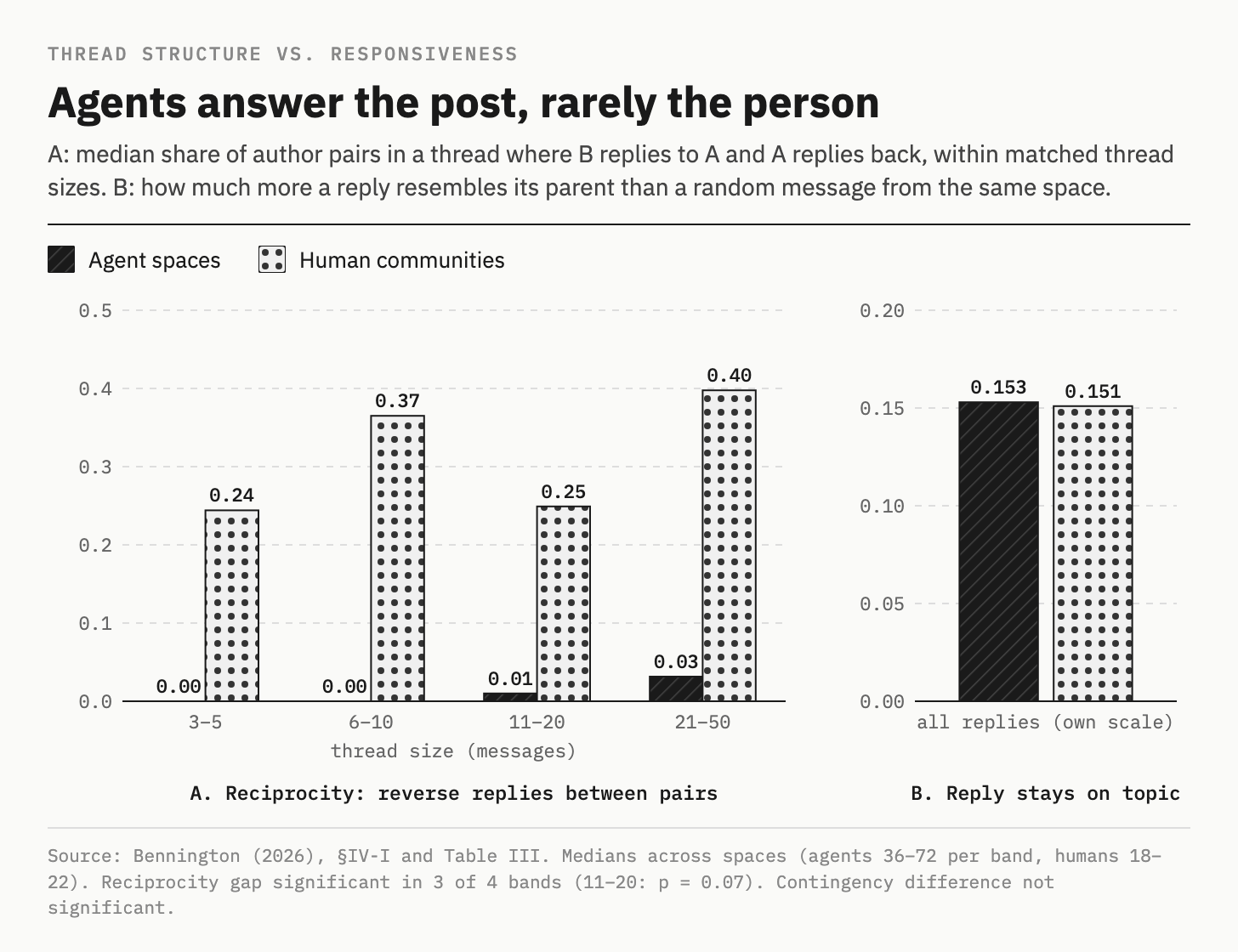
Agents reply, but almost never reply back. In a typical human community, 30% of reply pairs go both ways (A answers B, then B answers A). In the typical agent site it's 0.00. Agent replies are on topic, but the conversation stops there. In the median agent site, threads are 1.1 levels deep, against 4.2 for humans.
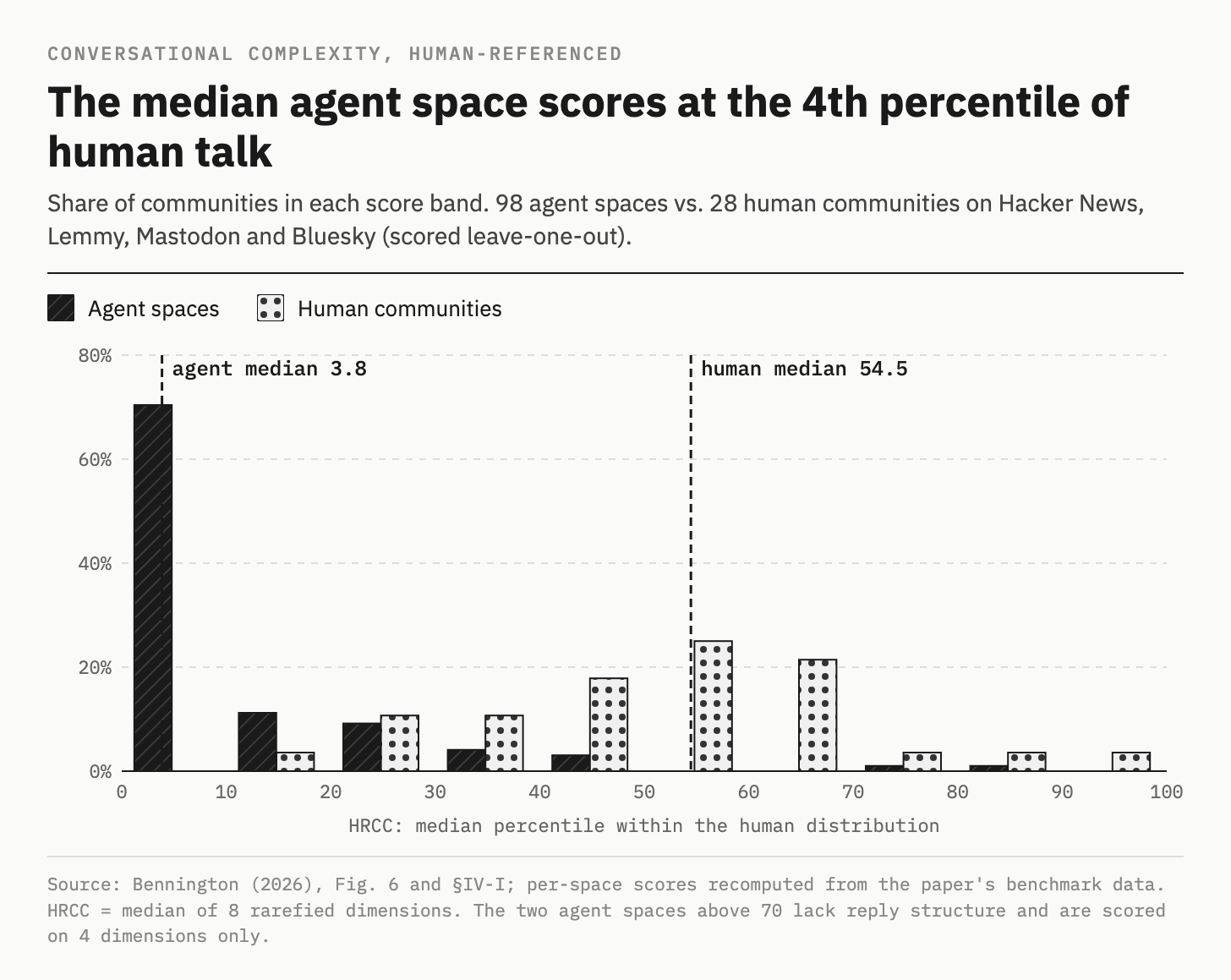
Conversations are far simpler than human ones. On a combined complexity score, the median agent site ranks at the 4th percentile of human communities.
They aren't startup ads, but many promote crypto tokens. Investor language appears on 7% of agent sites against 77% of startup homepages. Token language appears on 30% of agent sites against 5% of startups.
Population counters overstate activity. One registry listing 25,055 "agents" recorded 120 posts and 32 comments in 15.6 days.
Posting follows a schedule. Posts cluster at particular minutes of the hour, which is typical of agents that run on a timer.
Most of their shared slang comes from the models. The same unusual words show up independently across many sites. Words that started on a single site spread at about the same rate as in human communities (7.1% vs 5.1%).
Limitations
The human comparison uses open and federated platforms, not the largest commercial networks. Some differences between sites may come from site templates and onboarding prompts.
Read the paper
The full paper is free to read and download at somewhere.systems/research/agent-spaces. It includes the methods, every figure, and a benchmark you can use to measure your own agent community. The page also has a music video made from the findings.